
Having Favorites

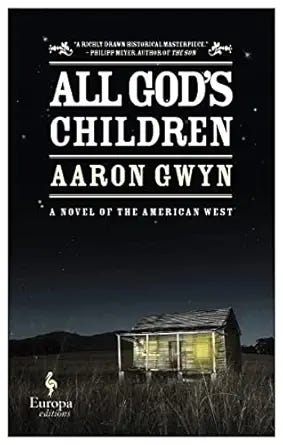
Though I spend little time over on Twitter these days, I was drawn in this week by a bizarre controversy touched off by Aaron Gwyn, who has become something of a talented literary imp on that platform in the last couple of years. Part of me wonders how worthwhile the investment of time and energy on such a promenading calamity of a website is, but to each his own. Though he and I have corresponded briefly and cordially, we haven’t ever met in person. By his writing, however, it’s clear that he is serious about writing and has no shortage of wisdom about how to go about it. And as a sidenote, his novel ALL GOD’S CHILDREN is one of my favorite novels of this decade. (You’re welcome, Gwyn. Mail me my cut by the end of the month, please).
Earlier this week, he posted what most serious writers would consider a benign entry. I’ll link it here for those brave enough to wade into the morass, but the brief summary is as follows: in his advanced fiction class, Gwyn is sometimes flummoxed when aspiring novelists are unable to name a favorite novel or novelist. Now this touched off all the detours of bad-faith counterargument that Twitter has achieved as a kind of perfection of form. The resulting protests have criticized his ableism, his gatekeeping, his inability to teach, his this, his that. But what’s most remarkable is that what he is saying here is something every writing teacher I know has frequently experienced. Perhaps it has always been a facet of writing workshops, but within the last several years, we have seen the rise of a very particular specimen: the writer who doesn’t read.
But it’s worse than that. It’s not just that these people aren’t reading. They actively abhor it. If anyone is out there driving the AI slop writing industry, it’s these folks.
This is an open secret. If there’s one consistent complaint among those who try to teach writing, it’s not only that the students don’t want to read. They actually have an active hostility to the idea that the production of art should be difficult, that it should demand a development of priorities.
Obviously, I’m not talking about everyone. There are plenty of people who understand that the pleasure of discovery is a direct result of undertaking what can feel, at times, like an insurmountable task. Also, I’m not attacking beginning writers who are just starting to get their feet wet. Anyone who teaches writing at any level knows encouragement is key. My day job is at a community college, and I love the chance to provide the spark for someone’s interest in reading because I believe it will lead to a richer life for them. What I’m addressing is the person who has devoted themselves to trying to make lasting art. Or who claims to be. I’m lucky that I am sometimes invited to teach at writing workshops where I come in contact with these folks, and it remains one of the highlights of my teaching career. When the mentoring process is working well, it is profoundly important for both the mentor and the mentee.
But the real thing I want to address is what started this dustup in the first place. Obviously, writers need to read. They need to read a lot. I threw my own little Twitter hand grenade into the mix this week when I said that a fiction writer needs to read a minimum of 25 novels a year. This has led to some of the same backlash that Gwyn has faced. Admittedly, I knew ahead of time that it would and welcomed it. As writers, we have to be willing to declare ourselves in this argument about literacy. And no, it doesn’t matter if it’s all novels or a mix of poetry, nonfiction, etc. It’s a heuristic, for God’s sake. What matters is that you prioritize reading in your life, even if it’s difficult to do so. Through this kind of reading life, you discover your own idiosyncrasies and aesthetic habits. You learn more about the way you think and feel.
And having favorites in your reading is where you really start to understand how your reading connects to your writing. I have had so many different favorites over time, and they have reflected who I was in so many surprising and exciting ways. They haven’t always been the most “literary.” There was a span of time in my late twenties when I read C.S. Forester’s Horatio Hornblower adventures with the enthusiasm of a nearsighted kid with a new pair of glasses. But that period, like the others, led me to understand my affinities and obsessions in a way that I couldn’t have possibly known before. It made my world larger. And who the hell wants to read a book by someone who hasn’t tried to make their world as large as it could possibly be?
I keep thinking about this. There's something fundamentally narcissistic about wanting others to read YOUR work but not having the time or inclination to read anyone else's.
To amplify your point, I would say that anyone who does not read for pleasure should stop writing right now—the world has no need of your contribution. Loving reading and literature is the only reason for writing, with no significant exceptions. When I was a mentee, I hung on every word of my mentor, wrote everything down, read everything he recommended. A real writer is invariably apprenticed to the greatest writers of all time. That any piece of writing has a chance of lasting a thousand years is what makes it such an awesome undertaking.